Event Technology for Festivals: Building the Show and the Site
August 24, 2026
It's day three of a four-day festival. The headliner goes on in ninety minutes, a storm cell just crossed the site, and one of the two generators feeding the east end of the grounds has thrown a fault. Nobody in the crowd knows any of this. Whether they ever find out comes down to decisions made eight weeks earlier, on a spreadsheet, in a room with no music in it.
Festivals punish improvisation. A corporate general session can absorb a bad call because the room is small and there's usually a wall you can hide a cable behind. A festival has acreage, weather, several stages running at once, and an audience that comes back tomorrow. Creative Day Technologies builds event technology at that scale, and the gap between a festival that runs and one that limps is almost never the gear list.
What Festival Event Technology Actually Covers
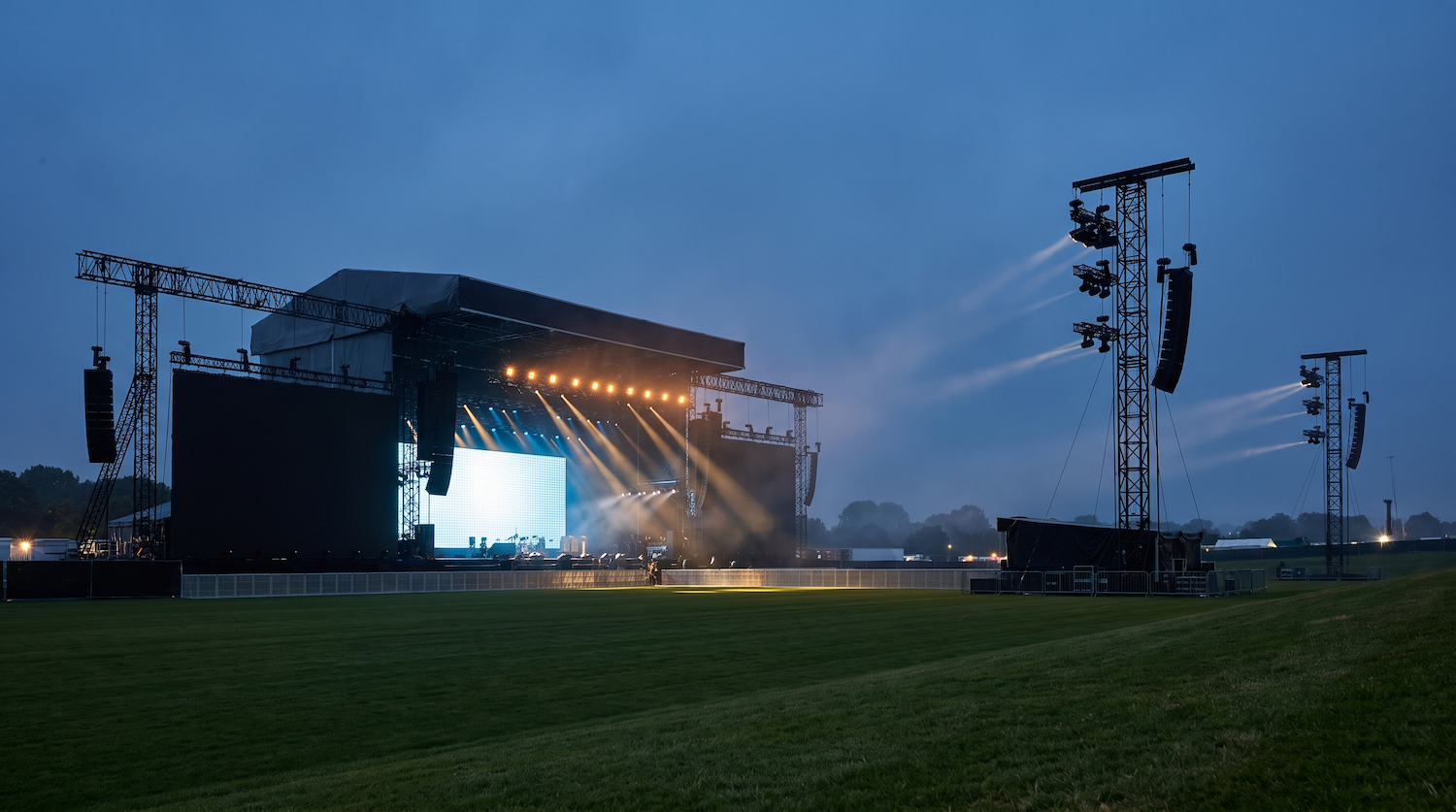
Festival event technology is the coordinated system of audio, video, lighting, power, rigging, and network infrastructure that keeps a large-scale, multi-day event running across several stages and several days without interruption. At a single-room corporate event, those systems are mostly independent. On a festival site they share the same power distribution, the same crews, the same load-in windows, and the same weather.
That shared dependency is the whole subject. You aren't designing an audio system and a lighting system that happen to be at the same event. You're designing one infrastructure plan that six departments draw from. Move a stage forty feet for better sightlines and you've changed cable runs, generator placement, rigging points, and how much sound bleeds onto the stage next door.
Audio Across Multiple Stages
Audio is usually the first system to expose a weak site plan, because sound ignores the boundaries drawn on a map. Two stages placed without a coverage study will fight each other all weekend, and the fix on site is always worse than the fix on paper.
- Coverage modeling before anything ships. Line array design, delay tower placement, and stage orientation modeled against real site geometry, so you know where sound lands and where it spills.
- Frequency coordination across the whole site. Every wireless mic, in-ear pack, and comms channel shares one RF environment. A single coordinated plan prevents the day-two dropouts that get blamed on "interference."
- Per-stage monitor worlds. Touring acts arrive with their own input lists and monitor engineers. Consistent patch setups per stage turn a half-hour changeover into a ten-minute one.
- Redundancy where an outage would be public. Backup consoles and doubled signal paths on the main stage, because that's the failure ten thousand people would witness.
Video and LED at Festival Distances
Video at a festival has a different job than video at a conference. In a ballroom, screens deliver content. On a field, LED walls deliver visibility, because most of the audience is too far away to see a face.
That changes the spec. Pixel pitch gets chosen for viewing distance rather than for resolution on paper. Brightness gets chosen for direct afternoon sun, the condition that embarrasses an under-specified wall. Camera positions and the IMAG plan matter as much as the wall itself, since a bright screen showing a badly framed shot still leaves the back half of the crowd watching a stranger.
If the event streams, that's a parallel production with its own switching, mix, and crew. Handing the stream to the video team as a side task is how remote audiences end up with a wide shot and audio that sounds like a phone recording.
Lighting That Has to Work at Noon and at Midnight
Festival lighting solves a problem indoor lighting never faces. The same rig plays in full daylight, at dusk, and in darkness, often for a different act every forty-five minutes. A design that looks striking at 11 p.m. can be invisible at 4 p.m.
Practical design for a multi-day site means weather-rated fixtures, cue stacks that adapt as ambient light drops, and enough structural capacity in the roof to hang what visiting lighting designers show up expecting. It also means the parts nobody photographs: path and egress lighting, back-of-house work light, and vendor areas that stay safe after dark.
Power, Rigging, and Connectivity
Most festival technology failures trace back to infrastructure rather than equipment. A console rarely fails on its own. It fails because something upstream did.
Power. Festival sites run on generators, and generator planning is load calculation plus honest headroom plus a plan for when one unit drops. Clean, isolated power for audio and video, separated from motor loads and vendor draw, prevents the hum and the brownouts that get misdiagnosed as equipment faults all weekend.
Rigging. Outdoor structures live under wind load limits, and those limits are engineering facts rather than suggestions. Ground-support roofs, certified riggers, weight capacities, and a documented severe-weather threshold belong in the plan before load-in, not in a conversation during a storm.
Connectivity. Ticket scanning, cashless payment, credential checks, radio comms, and streaming all compete for bandwidth on a site with almost no permanent infrastructure. Temporary networks need the same design care as the audio system, with prioritized traffic and hardline paths for anything mission-critical.
How You Coordinate Something This Intricate
Multi-day events are won by documentation and sequencing. The tools are unglamorous, and they work.
A phased load-in schedule
Trucks arrive in a sequence that matches build order, and only one department occupies a footprint at a time. Uncoordinated load-in is the most expensive mistake available on a festival site, because a stage crew standing idle behind a rigging crew burns labor hours nobody budgeted.
A run of show per stage, plus one master schedule
Each stage needs its own document covering set times, changeovers, and technical cues. Above those sits a master schedule that catches what individual stages can't see, like three headliner changeovers landing in the same fifteen minutes with two forklifts available.
Overnight reset windows
Day two doesn't start where day one ended. Batteries need charging, gear needs drying, consumables need restocking, and anything broken needs repairing or swapping. Reset time has to be scheduled and staffed, not assumed.
Technical rehearsal, even without the artists
Touring acts rarely sound-check on a festival bill. Your crews still need to test every system under load before doors, walking cues, checking comms, and confirming failover paths while the site is empty.
One accountable production partner
Split audio, video, lighting, power, and rigging across five vendors and you get five companies each certain the fault belongs to somebody else. A single production partner owns the infrastructure plan and owns the fix, which is what you want at 9 p.m. on day three. Our case studies include productions on sites with very little permanent infrastructure to build on.
Where Multi-Day Events Go Wrong
- Budgeting for one day and multiplying. Multi-day labor involves turnaround rules, overnight resets, and crew fatigue. It doesn't scale linearly.
- Treating weather as a contingency instead of a plan. Wind thresholds get decided in advance or they get decided badly.
- Under-specifying power. Generators sized with no headroom fail the moment a vendor plugs in something unexpected.
- Ignoring the second and third stages. Attention concentrates on the main stage while the smaller stages, where most of the audience spends most of the weekend, get the leftover crew.
- No single point of technical accountability. When every system is a separate contract, coordination becomes the client's job.
Frequently Asked Questions
How far in advance should festival event technology be planned?
Six months is comfortable for a mid-size festival, and larger multi-stage events benefit from nine to twelve. The long lead items are rarely the equipment. They're the site survey, power design, rigging engineering, and permitting.
How is festival production different from corporate event production?
Infrastructure. A hotel ballroom supplies power, rigging points, climate control, and internet. A field supplies dirt. Festival production means building the venue before you can build the show, which our guide to professional outdoor event production covers in more detail.
Can one production company really handle every stage?
Yes, and it's usually the better arrangement. One team means one frequency coordination plan, one power design, and one phone call when something needs solving. Individual stages can still host visiting engineers and touring gear inside that framework.
How do you handle severe weather on a multi-day event?
With documented thresholds set before load-in: wind speed limits for rigging, lightning distance triggers for holds, an evacuation plan, and one person with authority to call it.
Planning a Festival or Multi-Day Event?
Creative Day Technologies produces festivals, conferences, and large-scale outdoor events across the United States and parts of Canada, with offices in Detroit, Grand Rapids, and Las Vegas. We handle event technology as one integrated system rather than a stack of separate rentals, from site survey through final load-out. Contact us to walk through your site, your stages, and your schedule with a team that has built shows in fields before.
Creative Day Technologies specializes in audio-visual and event production for businesses and organizations across the United States. From single-room meetings to multi-stage festivals, we handle the technical complexity so you can focus on your message.